When Oedipus Was a Baby, Who Saved His Life?
Oedipus the Rex (429-420 BCE), besides known as Oedipus Rex or Oedipus Tyrannos ('Tyrannos' signifies that the throne was not gained through an inheritance) is the nearly famous surviving play written by the 5th-century BCE poet and dramatist Sophocles. The play is part of a trilogy along with Antigone and Oedipus at Colonus.
The plot - an former myth already known to most of the audition - was uncomplicated: a prophecy claiming he would impale his father and lie with his mother forces Oedipus - whose name ways 'swollen pes' after his ankles were pierced as a kid - to get out his home of Corinth and unknowingly travel to Thebes (his actual birthplace). En route he fulfills the commencement role of the prophecy when he kills a human being, the male monarch of Thebes and his true begetter. Upon arriving in Thebes, he saves the troubled city by solving the riddle of the Sphinx, then he marries the widowed queen (his mother) and becomes the new king. Later, when a plague has befallen the city, Oedipus is told that to rid the city of the plague he must find the murderer of the slain king. Unknowingly, ignorant of the fact that he was the culprit, he promises to solve the murder. When he finally learns the truth, he realizes he has fulfilled the prophecy; he blinds himself and goes into exile.
Sophocles
Sophocles (c. 496 BCE - c. 406 BCE) was born to a wealthy family unit in the deme or suburb of Colonus exterior the heart of Athens. As well existence an writer, he was extremely active in Athenian public life, serving as a treasurer in 443-42 BCE and a general 441-40 BCE. When he was in his eighties, he was named a fellow member of the grouping of special magistrates assigned to the dubious task of organizing both financial and domestic recovery in 412-11 BCE after the disastrous defeat at Syracuse. He had ii sons; Iophon by his wife Nicosrate and Ariston (as well called Sophocles) by his mistress Theoris. Both sons would somewhen get playwrights. Among his close friends were the historian Herodotus and the statesman Pericles.
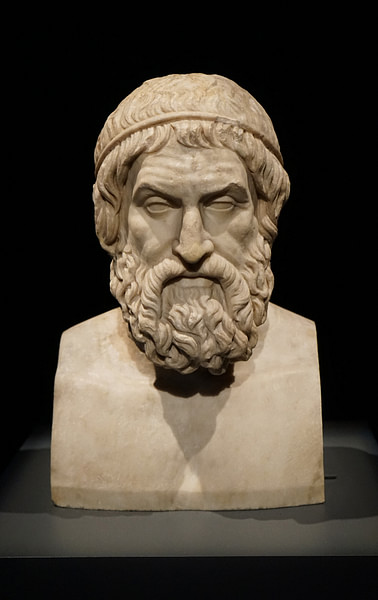
Bosom of Sophocles
Although active in Athenian political circles, his plays rarely incorporate any references to current events or issues - something that makes the dating of his plays difficult. Classicist Edith Hamilton wrote that he was a passionless, discrete observer of life. In her book The Greek Way, she said that the beauty of his plays was in their simple, lucid, and reasonable structure. He was the embodiment of what we know to be Greek. She wrote that "… all definitions of the Greek spirit and Greek art are start of all definitions of his spirit and his art. He has imposed himself upon the world as the quintessential Greek, and the qualities pre-eminently his are ascribed to all the rest" (198-199). She added that he was bourgeois in politics and believed in the established guild of things, even in theology. Author David Grene in his translation of Oedipus the King said that his plays had tightly controlled plots with complex dialogue, character contrasts, an interweaving of spoken and musical elements, and the "fluidity of verbal expression."
Main Characters
Oddly, while it was one of his most popular plays and so & now, it did non win outset prize.
Greek tragedians performed their plays in outdoor theaters at various festivals and rituals in competitions. The purpose of these tragedies was to non only entertain but also to educate the Greek citizen, to explore a problem. Along with a chorus of singers to explain the activeness, there were actors, often three, who wore masks. Sophocles' contemporaries included Aeschylus, author of Prometheus Spring, and Euripides, author of Medea. At the festival of Dionysius, Sophocles won 18 competitions, while Aeschylus won 13, and Euripides just five. Few accurate dates are known for his plays; Oedipus the King was probably written in the mid-420s BCE. This estimate is based on his reference to a plague that aggress the city during Oedipus's time on the throne. Oddly, while it was one of his about popular plays then and now, it did not win commencement prize.
The play's characters are few:
- Oedipus, the king
- Creon, his brother-in-law
- Teiresias, an erstwhile blind prophet
- Jocasta, Oedipus' wife and mother
- two messengers
- a herdsman
- a priest
- and, of course, the chorus.
Plot Summary
The play opens with the metropolis of Thebes in turmoil, beset by a plague. A priest speaks to Oedipus:
A blight is on the fruitful plants of the earth, a blight is on the cattle in the fields, a blight in on our women that no children are born to them… (Grene, 74)
He reminds the male monarch that he had freed the city from the tribute paid to the Sphinx, and now the city pleads for him to discover some way to rescue the city and "set it directly." Oedipus replies that he understands the plight of the people and has sent his brother-in-law Creon to the temple of Apollo (often referred to in the play as King Phoebus) to notice an answer. Upon returning to the city, Creon requests to speak to the rex in individual, simply Oedipus replies: "Speak it to all, the grief I behave, I comport it more than for these people than for my own life" (77). To rid the city of the plague they must notice the murderer of King Laius. Knowing little nigh the former king's death, Oedipus listens to the details of the murder, a crime supposedly committed past robbers. He vows to find the murderer:
Whoever he was that killed the king may readily wish to dispatch me with his murderous hand: then helping the expressionless king I help myself. (79)
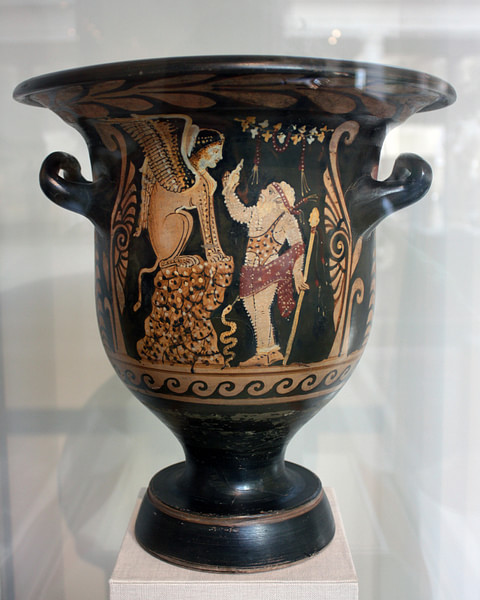
Oedipus & the Theban Sphinx
Oedipus speaks to the audition, begging that if anyone knows the murderer to come forward, promising that he has no penalization to fear, only exile. However, he invokes a curse:
… whether he is one man and all unknown, or i of many - may he wear out his life in misery to miserable doom. (82)
He is told of a local bullheaded prophet, Teiresias, who often sees what Apollo sees and might help him solve the murder. Notwithstanding, after the prophet arrives, he is afraid to speak, fearing for his life if he tells the truth. Oedipus pleads, "Yous know of something simply refuse to speak. Would y'all betray us and destroy the city?" (86) To try and force him to speak, Oedipus accuses him of being part of a plot. Reluctantly, the old prophet relents, telling Oedipus that he, himself, is the murderer. Oedipus is irate, threatening Teiresias. The old homo replies that Oedipus taunts him "with the very insults which everyone shortly will heap upon yourself" (89). The king questions if this accusation comes from him or Creon. The old prophet replies that Creon is non to blame. The old prophet then inquires of Oedipus if he knows who his parents are, adding that a "curse from father and mother both, shall drive you forth out of this land, with darkness on your eyes" (91).
Oedipus and Creon come across to talk. Immediately, Oedipus threatens his brother-in-law, calling him a traitor and plotting against him. In defense, Creon asks if he is to exist banished. When Jocasta arrives, the king tells her that her brother is plotting against him, but she replies in defense, "… what was it that roused your anger and so?" (104) He tells her that Creon accuses him of killing her married man, the rex. She responds that he should not business concern himself with the matter and tells him of the prophecy of the oracle and the death of her hubby:
… it was fate that he should die a victim at the hands of his own son … (b)ut see at present, he, the rex was killed by foreign highway robbers at a place where three roads meet. (105)
With his curiosity aroused, Oedipus asks about the murder: How long agone was it? What did he expect similar? How onetime was he? She tells him of the merely survivor, an erstwhile servant who was sent away. Oedipus asks to speak to the old human being, and if their stories are the aforementioned, he will be free of any guilt.
Oedipus then relates the story of his own departure from Corinth. He had been called a bastard at a dinner party held past his parents, the rex and queen. Although his parents denied the allegation, he soon learned that a prophecy blighted him to murder his father and lie with his mother. To avoid fulfilling the prophecy, he fled the city only to come to a crossroads where he encountered a carriage. A dispute ensues and he ends upwardly killing the railroad vehicle's occupant and the driver. "I killed them all." He asks of Jocasta, "Was I not born evil? Am I not utterly unclean?" (110)
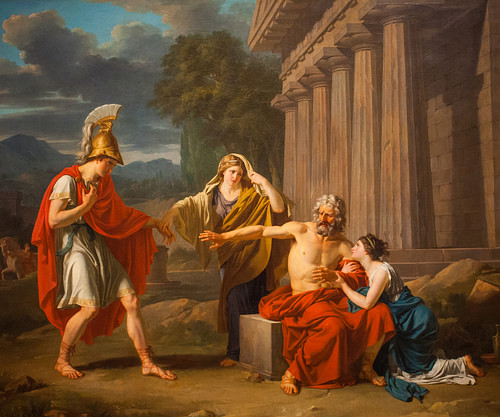
Oedipus at Colonus
A messenger arrives to tell Oedipus that his father, the king of Corinth is dead. Oedipus realizes that the old prophecy was incorrect.
They prophesied that I should kill my father. But he's expressionless and hidden deep in the earth, and I stand here who never laid a hand or spear near him… (116)
However, he is confused and not completely relieved, still fearing that the prophecy may be proven to exist truthful. The messenger adds that Male monarch Polybius was not Oedipus' real father, for he had received a baby - Oedipus - from a shepherd and given it to the male monarch. Oedipus realized that this shepherd was the same homo who had been sent away past Jocasta. To help appease the king's anguish Jocasta tells Oedipus that she hopes the gods keep him from finding out who he really is.
The old herdsman arrives to speak to Oedipus. Subsequently the king pressures him, he reluctantly relates the story of how he had pitied the babe that came from the house of Laius and given it to the messenger. Afterwards hearing the herdsman'southward confession, Oedipus is beside himself, begging for a sword so he could kill his wife, his mother. Speaking to the chorus, a second messenger arrives and tells that the audience that Jocasta is dead; she had committed suicide. When Oedipus enters her room, he finds her hanging with a twisted rope effectually her neck. He tore the brooches from her robe and stabbed himself in his eyes, repeatedly. Blinded, he begs to exist shown to the men of Thebes equally his father'south killer. He laments: "Why should I see whose vision showed me nothing sweetness to meet?" (134) He proclaims that he is godless and a child of impurity. "If there is any ill worse than ill, that is the lot of Oedipus" (135). Creon comes to him but not to laugh, only to ask what he could do. Oedipus asks to give Jocasta a proper funeral, and for himself, to be driven out and alive "away from the urban center."
Legacy & Oedipus Complex
Oedipus the Rex was not only staged throughout antiquity merely is withal performed to this twenty-four hours and is required reading in many schools. It survived equally the model for plays by such noted authors every bit Seneca, Dryden, and Voltaire. The psychoanalyst Sigmund Freud even coined the phrase "Oedipus Complex" to describe the developmental stage when one may experience a want for ane'south parent of the opposite sexual activity. David Grene wrote that Oedipus serves as "a metaphor for every human being'due south quest for personal identity and self-knowledge in a world of ignorance and man horrors" (11).
This commodity has been reviewed for accurateness, reliability and adherence to bookish standards prior to publication.
Source: https://www.worldhistory.org/Oedipus_the_King/
0 Response to "When Oedipus Was a Baby, Who Saved His Life?"
Post a Comment