How Many Babies Are Born Each Second in the Us in 1970
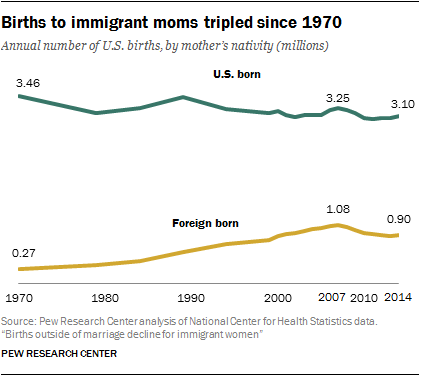 In 2014 more than 900,000 births in the U.S. were to foreign-born mothers. That marks a threefold increase from 1970, when 274,000 babies were born to immigrant mothers10 The tendency in births to U.S.-born women has moved in the opposite management – from 3.46 million births in 1970 to 3.x million in 2014 (an xi% drib). As a result of these divergent trends, the increase in the overall number of U.Southward. births, from iii.74 million in 1970 to 4.0 million in 2014, is due entirely to births to foreign-born mothers.11
The annual number of births to all mothers – immigrant and native born – fell off substantially during and after the Great Recession. Birth declines among the foreign born were both more dramatic and more enduring than those of U.S.-built-in women. While the number of births to U.S.-born mothers began to inch dorsum up as early on as 2012, information technology wasn't until 2014 that the number of babies born to foreign-born women ticked up.
Fifty-fifty given the birth declines associated with the Bang-up Recession, by 2014, 23% of all babies born in the U.South. had immigrant mothers, up from only 7% in 1970. This long-term rise in the share of births to foreign-built-in women is partially – but not entirely – driven by growth in the overall U.Southward. immigrant population. In 1970, just v% of the U.Due south. population was foreign born; by 2014, that share had grown considerably, to 14%.
I cistron likely contributing to the disproportionate share of births to immigrant women is the age and sex structure of the population. In 2014, while 14% of the entire U.S. population was comprised of immigrants, fully 17% of childbearing-age women in the U.S. were foreign built-in.
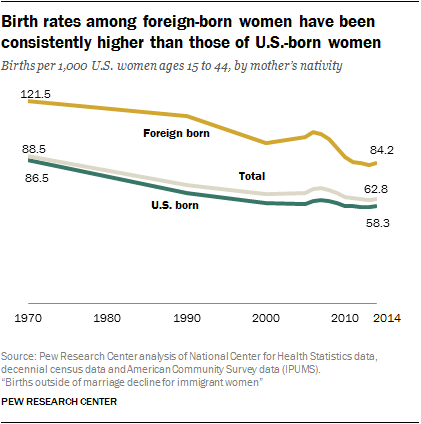 Nativity differences in the historic period and sex activity contour don't explain all of the fertility differences between the foreign born and U.South. born. Fifty-fifty taking into consideration the growth in the share of immigrant women of childbearing age, it's notwithstanding the instance that foreign-born women account for a disproportionately large share of births. This is due in office to the fact that foreign-born women in the U.South. take higher fertility than their U.S.-born counterparts. In 2014, the birth rate – children born per one,000 women of childbearing historic period – stood at 84.2 for immigrant women. In comparing, the charge per unit for U.Southward.-born women was 58.three. In other words, a foreign-built-in woman of childbearing age was about 44% more than probable than her U.S.-born counterpart to have had a recent birth.12
This has been a consistent pattern since at least 1970, when the modernistic wave of clearing, mainly from Latin America and Asia, was getting underway. The birth charge per unit that year was 121.5 for immigrant women, while the rate for U.S.-born women was 86.v.
In 2006, only before the start of the recession, nativity rates of strange-born women were almost 70% higher than those of U.Southward.-built-in women (103.0 vs. 61.v). These differences accept macerated somewhat since then, as immigrant birth rates have declined more rapidly than the birth rates of U.South.-built-in women in the wake of the Great Recession.
Though overall U.S. birth rates ticked upwards just prior to the recession, in the long term, they have declined noticeably. In 1970 the rate was 88.5 births per one,000 women of childbearing age, and after hitting a historical low of 62.three in 2013, rates inched upward for the get-go time since the recession in 2014, to 62.8.13 The 2014 U.S. birth rate is well-nigh 29% lower than it was in 1970.14 For both the foreign born and U.S. born, long-term declines in fertility have been more dramatic – by 2014 the rate among the foreign born had dropped 31% since 1970 and among the U.Southward. born, at that place was a 33% turn down.xv
U.S. births to unauthorized immigrant parents
Most 275,000 babies were born to unauthorized-immigrant parents in 2014, or nearly vii% of all births in the U.Due south. that year, according to new Pew Research Centre estimates based on government data. This represented a decline from 330,000 in 2009, at the end of the Great Recession.
Births to unauthorized immigrants accounted for well-nigh one-in-three (32%) births to foreign-born mothers in 2014, according to the estimates.
The 2014 estimates of births to unauthorized immigrants are based on information from the Demography Bureau'south American Community Survey, using the widely accepted residual methodology employed by Pew Enquiry Center for many years. Past comparing, the findings in this report near the number of U.South. births to foreign-born mothers are based on data from the National Heart for Health Statistics. Both information sources produce very like results in terms of the number of U.Southward. births to immigrant mothers and their share of all U.Southward. births.
Source: https://www.pewresearch.org/social-trends/2016/10/26/growth-in-annual-u-s-births-since-1970-driven-entirely-by-immigrant-moms/
0 Response to "How Many Babies Are Born Each Second in the Us in 1970"
Post a Comment